Monday, 5 May 2014

BONDING AND STRUCTURE

After that last post I feel like I need to do something easier or you'll all freak out on me. This one is less understand and more just memorising. It's just going through the notions of reading question and seeing how many electron pairs its talking about and also what kind, LONE or BONDED? I'll go through that in a minute. 

In a way you could compare this chapter to Assassin's Creed, you read the question and as soon as the answer flies past you, you attack it and stab it to the page so it stays there, or maybe that's just me.


Coming up: Some definitions.


IONIC BONDING: The electrostatic attraction between oppositely charged ions. 


You may need to construct a "dot and cross" diagram to show this. Simply figure out which atom will lose an electron and which one will gain that electron (or more). The one which lost the electron has a charge of +1 the one which gained the electron will have a charge of -1. Now you all know that opposite charges attract so these ions also attract to form a compound.


Now draw the positive ion with an empty shell (or a lower shell that is full), brackets round it and a charge of +1 and next to it draw a diagram of the -1 ion with its own electrons as crosses and the extra electrons as circles (or visa versa). Don't forget the brackets!


It's quite wordy to explain it but it is very simple in practise, quite literally free marks in the exam.


Example: A reaction between Magnesium and chlorine. The magnesium loses two electrons to have a full outer shell and chlorine needs 1 electron each to have a full outer shell (so two chlorine atoms required). The magnesium donates the 1 electron to each chlorine and they become ions. Chlorine with -1 charge each and Magnesium with +2 charge. 


You are required to know the formulae of the following ions:


NO3: -1

CO3: -2
SO4: -2
NH4: +1

COVALENT BOND: Shared pair of electrons.


Unlike in ionic bonding, during covalent bonding the electrons are shared, not given away. This forms a bond equal in strength to ionic bonding. However covalent bonding occurs between non metals, whilst ionic bonding occurs between metals and non metal (except hydrogen and a non metal).


It is also important to note that a covalent bond is directional (acting only between the two atoms involved in the bond) whilst ionic bonding attracts in all directions (often forming a lattice - Like a net).


Here is a good guide on how the bonds are formed. The individual atoms have only one role is life to form a full outer shell, so that they may be stable and lead a happy atomic life.


Sometimes a DATIVE COVALENT bond forms. This happens when a molecule, once bonded, a lone pair of electrons and it chances to meet a +1 ion so the two react together to form positive ion with no more electrons to pair up.


LONE PAIR: Outer shell pair of electrons which are not involved in the chemical bonding.


DATIVE COVALENT BOND: A shared pair of electrons which has been donated by ONE of the bonding atoms.


Now we get onto the tough memorisation part: SHAPES! <---- Ugh the horror. Make sure you remember the examples AND the bonding angles AND the names.


The shape of the molecule is determined by repulsion between electron pairs surrounding the central atom.Lone pairs repel more than bonded pairs.


VERY IMPORTANT.


The type of bonding very much depends on something called the ELECTRONEGATIVITY.
 ELECTRONEGATIVITY: It is the attraction of an atom on the bonded pair of electrons.

In short? The more electronegative an atom is the more it wants those electrons. So when you get two atoms which have a high difference in electronegativity, this results in a permanent dipole to form (one of the atoms becomes slightly positive and the other slightly negative). The resulting dipole results in a polar bond to form. 

When the difference in electronegativity is very high then ionic bonding occurs where the atoms do not become slightly charged but have a full charge on them.

When there is no difference is electronegativity the reacting atoms form a covalent bond and share the electrons equally, they're not greedy.

However sometimes in a diatomic molecule (E.g. F-F or Cl-Cl) the electrons may be distributed unevenly. This results in an instantaneous dipole. This dipole will induce a dipole in the neighbouring molecule. The attraction between the instantaneous dipoles is Van der Waals's forces. The greater the number of electrons the greater the Van der Waal's forces.

This attraction is temporary and the electrons will move to another random place and create another instantaneous dipole in another direction.

There is another type of bonding that you need to know. It's called hydrogen bonding and yes it involves hydrogen.

HYDROGEN BONDING: A strong dipole-dipole attraction between an electron deficient atom and a lone pair on another molecule.

This type of bonding is strong (weaker than covalent but stronger than Van der Waals) and can only occur between molecules containing N-H and O-H.

This type of bonding give water very special properties:

  • Ice is less dense tan water. Usually solid is more dense than liquid. However, in water (when freezing) more hydrogen form which hold then molecules apart. When ice melts again, the bonds break allowing the molecules to come closer together.
  • Water has a relatively high melting/boiling point. This is because on top of Van der Waals there are also hydrogen bonds that need to be broken. Extra bonds - Extra energy.
  • High surface tension and viscosity (thickness) of water. This all due to hydrogen bonds.

Final type of bonding is Metallic bonding.

METALLIC BONDING: The attraction of positive ions to the delocalised electrons.

Nothing to add there, very simple. All in the name: you have a metal that becomes +1 ion there will be one delocalised electron per each positive ion.

All the bonding is very important so make sure you memorise it as it needs to be applied to some higher end questions. Here is a quick summary:

  • Ionic bonding
  • Covalent bonding
  • Dative covalent
  • Electronegativity
  • Permanent dipoles - Polar bonds
  • Instantaneous dipoles - Van der Waals
  • Hydrogen bonding
  • Metallic bonding

There are many different structures (Eiffel tower and the pyramids being one of them):

Giant ionic lattices: These include ionic bonding which is very strong - E.g. NaCl (the common salt).
  • High melting and boiling point - Strong forces means lots of energy.
  • When solid the ions are fixed but when molten or in a solution the ions are free to move.
  • Ionic lattices dissolve polar solvents, such as water. The lattice is broken down by the water molecules which surround each ion.
Giant covalent lattices: They have very strong covalent bonds - E.g. Carbon structures such as diamond and graphite.
  • High melting and boiling points - Strong covalent bonding.
  • Non conductor of electricity as there are no free charged particles that can move.
  • They are insoluble in both polar and non polar solvents, as the covalent bonds are too strong to be broken by solvents.
Giant metallic lattices: Quite obvious, they have metallic bonding which is very strong.
  • High melting/boiling points - Strong metallic forces.
  • Good conductors as delocalised electrons can move.
Simple molecular lattices: Include hydrogen bonds which are moderately strong - E.g. Water.
  • Relatively high boiling point - Moderately strong hydrogen bonds.
Simple molecules: Only Van der Waal's forces attract the molecules together, fairly weak - E.g. I2.
  • Low melting and boiling points - Weak Van der Waals's forces.
DIAMOND:


These shiny crystals are nothing more than carbon - literally. The carbon atoms are joined together by strong covalent bonds, which means a very high boiling/melting point. 

They are rubbish at conducting electricity as there are no delocalised electrons and all outer electrons are used up in bonding. (I mean if you're running and juggling you can't be playing the piano at the same time, can you??)

On top of this they are very hard as the tetrahedral shape allows the applied force to be spread throughout the whole structure. (Another great example: when you're at a concert and you throw your self into the crowd - their hands will keep you from falling and they won't really feel your weight as it is spread out onto many people, easy eh??)

GRAPHITE:


Believe me or not this is diamond's sister (though not as shiny). It is also made of carbon alone. However graphite is made of strong covalently bonded layers, which is why you can draw with a pencil (the layers slide off).

It is a good conductor as there are delocalised electrons between the layers, which can move.

Unlike diamond, graphite is soft. This is because there are only weak Van der Waals's forces between the layers which allow them to slide off easily, even though the bonding within each layer is strong.

IONISATION ENERGY


Plasma ball by carredNow, everyone this is where I get really EXCITED - you'll see the connection later - as this is my favourite part.

Plasma is a super heated gas that has become ionised. This means that the electrons have enough energy to break from their shell and move around (though they don't fly off into distance). 


Though now we're getting into the physics field so I have to be careful as some chemists simply dislike physics (God knows why - Physics person myself).

You may be asking what has all of this got to do with ionisation energy? Good question, not much, well maybe a little. 

Ionisation energy is the energy required to remove 1 mole of electrons from 1 mole of atoms in a gaseous state.

In a plasma, electrons get freed but they need some energy to get excited (there now - get it) and leave their shell. This is the ionisation energy though in this case the electrons get removed from the compound completely to form an ion. So unlike in a plasma where the electrons swim in a "sea" surrounding the positive ions (like in a metal) during ionisation the electron is removed to produce an ion.

The ionisation is influenced by three main factors:
  • Nuclear charge: As it increases the attraction on the outer electron increases so ionisation energy increases.
  • Electron shielding: As the number of shells increases the ionisation energy decreases as there is a weaker attraction on the outer electron.
  • Atomic radii: The further away an electron is from the nucleus (so the greater the radius) the easier it is to remove it as the attraction of the nucleus on it is much weaker, so ionisation energy decreases.
Electrons exist in shells AKA quantum levels. Each shell is made from different sub shells. Each sub shell contains only the same type of orbitals and each orbital can only hold 2 electrons of opposite spin.

ORBITAL: A region that can only hold 2 electrons of opposite spin.

SUB SHELL: A group of the same type of atomic orbitals within a shell.

SHELL: A group of orbitals with the same quantum number.

If we now image one electron as a cloud, as it very difficult to know the exact position of an electron we will just assume that the electron can be anywhere within that cloud. This an atomic orbital. If we have two electrons, we don't have two clouds (or regions where the electron can be) - it's one orbital but twice as dense.

Those clouds - orbitals - can take various shapes, when they overlap even stranger things happen. Remember the orbitals are 3D and you do not need to know all the orbital shapes only these:
  • S - Orbital: Spherical in shape. Each shell contains only one s-orbital therefore in one shell this gives a total of 2 electrons.
  • P - Orbital: Dumb bell shape. There can be up to 3 p orbitals in each shells so a total of 6 electrons.
  • D - orbital: Up to 5 orbitals in each shell. Total of 10 electrons in a shell.
  • F - Orbital: Up to 7 orbitals in each shell. Total of 14 electrons in a shell.


This is a scary overview of how all the combinations of orbitals look. Below are the shapes you actually do need to know.


Lastly you may need to give an electron configuration so use your periodic table to correctly identify the orbitals and the number of electrons in a shell. Also remember that the 4s orbital is filled in first before the 3d orbital. The 4s orbital is also emptied before the 3d orbital. This is because the 4s orbital has a lowe energy level thatn 3d.


Let me give you a couple of examples:
O: 1s2 2s2 2p4
CA: 1s2 2s2 2p6 3s2 3p6 4s2
Fe: 1s2 2s2 2p6 3s2 3p6 4s2 3d6

Here are some rules to help you get your head round it all (it is a very confusing chapter but you'll be all right. 
  • Electron fill in the lowest energy level first.
  • Each orbital is filled with a single electron first before pairing starts.
  • When two electron enter the same orbital they must have opposite spins.


Its like old ladies on a bus, they will fill in from the front first and sit on separate seats and when all have been filled singly then they sit next to someone else.


REDOX

Now to tackle one of the hated parts of chemistry, unless you are a maths Genious (high five!) or love chemistry so everything's dead easy for you anyway.

REDOX
oxidation reduction


Thought this may seem useful for you guys. Seems very AWESOME actually.


In REDOX reactions some things will get OXIDISED and some things  will get REDUCED.
Oxidation is the loss of electrons and reduction id the gain of electrons.My friend finds it very easy to remember which one is which by this very simple mnemonic OIL RIG.

O: Oxidation
I: Is
L: Loss

R: Reduction

I: Is
G: Gain

I simply think about it, reduction means go down so the charge (oxidation state) will get more negative therefore reduction id gain of electrons. So now you know oxidation is the opposite.

You all have different memories so pick and chose.

There are some rules which you will have to memorise in order to help you in the exam to remember how to work out oxidation states. Remember when it even mentions REDOX or reduction or oxidation you'll know which guns to take out.

Group 1: +1
Group 2: +2
Group 7: -1
Oxygen: -2, Unless it is Hydrogen peroxide then O: -1
Hydrogen: +1, unless it is metal hydrides then H: -1
Transition metals: You will be told in the question, it will give you a Roman number.

An element on it's own has a oxidation number of 0. And unless a molecule has a charge on it then the oxidation states of the atoms within MUST cancel out.

Now something to calm you down:
  • Metals form + ions so they lose electrons. They get oxidised as their oxidation number goes up.
  • Non-metals generally form - ions so they are reduced because they gain electrons and their oxidation number gets more negative.
Ian-Chemistry-Cat

ACIDS


Now ladies and gentlemen, things are going to get very Factual so get your notepads out and shift your brains in gear for its time to memorise some definitions.

Oh and here's a very awesome cat I found.


As I'm sure you're all aware each acid contains a H+ ion. Sounds familiar?? I hope so. Then what an acid is should also click into place: Acid is a proton donor. Which just means that in a reaction the acid will give up its H+ ion to swap it for something else. And what is a H+ ion, well it's just a proton all by itself.

You are also expected to name some common acids and know their formulae. So I've made this easy for you and listed them here:

Hydrochloric acid: HCl
Sulphuric acid: H2SO4
Nitric acid: HNO3

The opposite, or the counterpart of you will, of an acid is a base. And also have to know some bases:

Metal oxides: MgO
Metal hydroxides: Mg(OH)2
Ammonia: NH3

These, I'll tell you straight away, can be used to neutralise acidic soil because when you add acid to base in the right amounts you produce water or a neutral solution and salt.

An Alkali is a soluble base that releases OH- ions in an aqueous solutions. So whereas an acid releases (donates) a H+ ion and alkali donates a OH- ion.

When an acid and alkali react together in the correct amount a neutral solution is formed, like I mentioned above. However a salt is always formed. A SALT is produced when the H+ ion is replaced by a metal ion or NH3.

You need to also be able to explain that a base accepts H+ ions from an acid (like I said a couple of times). For example:

  • OH- and H+ ions give H2O
  • NH3 and H+ give NH4+ ion.
There is also another part to acids that you may hate, or love depending on your view point of Chemistry and maths in general. It is water of crystallisation. When a crystal forms (salt) there is bound to be some water molecules locked up in there this a hydrated salt. An Anhydrous salt is a salt without water.

To work out the water of crystallisation you need to:

  1. Work out mass of the hydrous and anhydrous ( or you may be given them).
  2. Take them away from each other. This will give you the mass of the water.
  3. Now work out the moles of water and the anhydrous salt (using the triangles that you have learned).
  4. Once you have the moles divide both values by the smallest one, this will give you the ratio of anhydrous salt to water.
  5. Ta dah! You have worked out the water of crystallisation. The value of the ratio for water is the answer. Stick that in front of the water and BOOM!
  6. Make sure you have a DOT "." before the H2O to ensure that this is a water of crystallisation and not some crazy molecule you just came up with.

MOLES and EQUATIONS

Don't worry this part of the course isn't about actual moles:


Though I'm sure I'll find someone here who will go: Awww, why not ^_^ (Sorry)

When talking about a mole of a substance you can't think about furry little atoms that dig underground all their life, it doesn't work like that, again sorry ^_^

A MOLE of a substance can be explained in many different ways.
  • Amount of substance
  • The Avogardo's constant (sound cool, doesn't it - you'll learn to love and hate it soon) 

If we take IRON with molecular mass of 55.8, for example, the amount of 1 mole of iron would be 55.8 grams. See the connection yet??
Okay, 1 mole of Xenon (why not??) with molecular mass of 131.3 is 131.3 grams. Well... Isn't this magic? Its not, sorry so many disappointments.

Now you may ask if we have 3.5 moles of something how much is that? Well, you might have figured that out already that you'd multiply the molecular mass by 3.5. To make life easier this is the formula:
Now, when talking about Avogadro's constant life gets so much more interesting. A mole of ANY substance contains exactly 6.02 × 10^23 mol-1 particles.

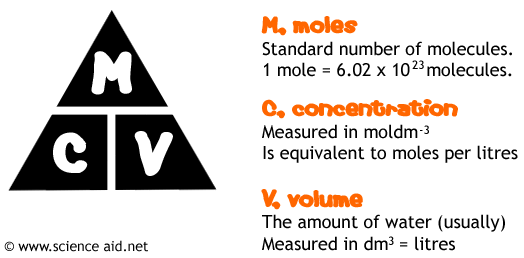
You may also need to calculate concentrations and volume of aqueous solutions so here is another triangle, which is pretty much self explanatory - find what you need to work out, see what you've got,, find the right triangle and then your best friend calculator will do the rest.

triangle used to calculate concentration, moles or volume, with units

Examiners also like to put another type of calculation just to throw you, so watch your units!! You may have to calculate the gas volume of, well, a gas.


Remember that 1 mole of gas molecules will occupy 24 dm^3 at room temperature and pressure.

Well, that's pretty much it at the moment, I mean when it comes to moles it does. Oh, I would have forgotten completely (my chemistry teacher would kill me if I didn't say this). 

REMEMBER ABOUT STOICHIOMETRY. 

Sounds gibberish? Well all it means is always look at the ratio of moles in the equation you'll be given.

Now for those Linkin Park fans out there: In the end it doesn't even matter cos you know it all, so when they come for you with those equations you'll not be Powerless any more.